

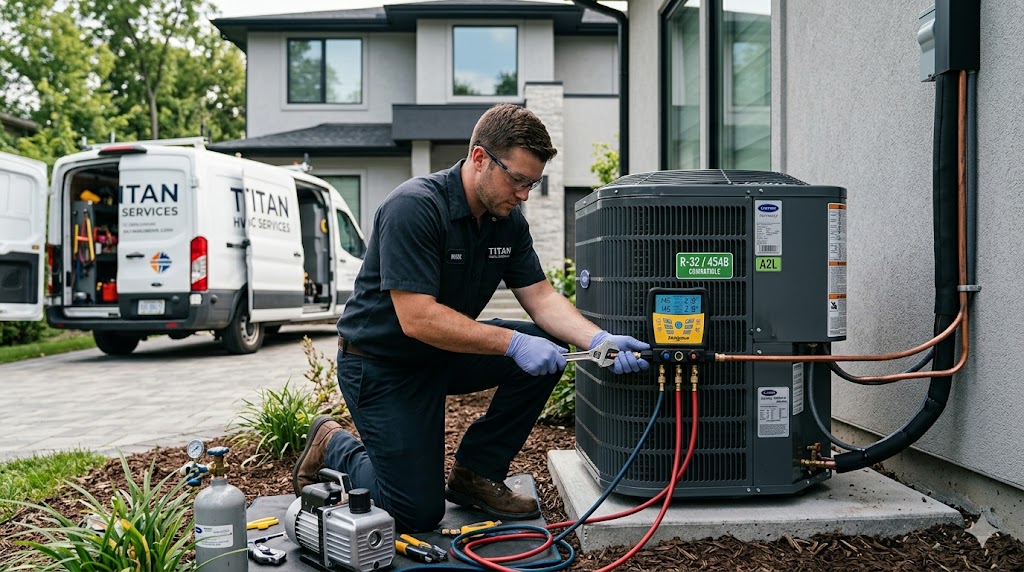
Are R-32 and R-454B Dangerous? The Real Truth About A2L Refrigerants
The HVAC industry is entering one of the largest refrigerant transitions in decades.
As regulations phase down high-GWP refrigerants like R-410A, manufacturers are introducing new alternatives such as R-32 and R-454B.
These refrigerants are part of a classification called A2L mildly flammable refrigerants, and the word flammable has raised concerns among many HVAC contractors.
Technicians frequently ask questions such as:
• Are R-32 and R-454B dangerous?
• Can these refrigerants ignite inside a home?
• Should contractors be worried installing A2L systems?
The reality is that while these refrigerants are technically flammable under laboratory conditions, their ignition requirements are extremely difficult to achieve in real HVAC installations.
Understanding the science behind A2L refrigerants helps contractors safely work with the next generation of HVAC equipment.
Why the HVAC Industry Is Transitioning to New Refrigerants
For more than twenty years, most residential air conditioning systems used R-410A refrigerant.
While R-410A does not damage the ozone layer, it has a relatively high global warming potential (GWP).
R-410A GWP
≈ 2,088
International environmental policies such as the Kigali Amendment are driving the transition to refrigerants with lower environmental impact.
Two of the most widely adopted replacements are:
• R-32 refrigerant
• R-454B refrigerant
Both offer dramatically lower GWP while maintaining strong cooling efficiency.
What Makes A2L Refrigerants Different?
R-32 and R-454B are classified as A2L refrigerants, a category defined by ASHRAE.
The classification means:
A – Low toxicity
2L – Mild flammability with slow flame propagation
The term “mildly flammable” often causes confusion.
Unlike fuels such as propane or gasoline vapors, A2L refrigerants have very strict ignition requirements that make combustion unlikely in real-world HVAC systems.
How Flammable Are R-32 and R-454B?
To understand their safety, it helps to examine the physical properties that determine ignition.
Three scientific metrics determine flammability:
-
Lower Flammability Limit (LFL)
-
Minimum Ignition Energy
-
Burning Velocity
| Property | R-32 | R-454B |
|---|---|---|
| Lower Flammability Limit | ~14% concentration in air | ~13% concentration |
| Minimum Ignition Energy | ~30–100 mJ | ~30–100 mJ |
| Burning Velocity | ~6.7 cm/s | ~1.5 cm/s |
For comparison:
| Substance | Burning Velocity |
|---|---|
| Propane | ~46 cm/s |
| Natural gas | ~38 cm/s |
| R-32 | ~6.7 cm/s |
| R-454B | ~1.5 cm/s |
This means propane flames spread 7–30 times faster than A2L refrigerants.
This slower flame propagation is why these refrigerants are categorized as mildly flammable instead of highly flammable.
What the Flammability Limit Actually Means
The Lower Flammability Limit (LFL) is the minimum concentration of refrigerant in air required for ignition.
For R-32, the refrigerant must reach approximately 14% of the air volume before ignition is possible.
To understand how unlikely this is, consider a typical residential bedroom.
Example
Typical bedroom size:
12 ft × 12 ft × 8 ft ceiling
Total air volume
≈ 1,150 cubic feet
For R-32 to reach the flammable concentration in that room, it would require roughly 160 cubic feet of refrigerant vapor.
That would require a catastrophic refrigerant leak far larger than what exists in normal residential HVAC systems.
In reality, refrigerant disperses quickly and rarely approaches these concentrations.
Can R-32 or R-454B Explode in a House?
One of the most common contractor concerns is whether these refrigerants could explode inside a home.
The short answer is no under normal HVAC conditions.
An explosion would require three things to happen at the same time.
The Three Conditions Required for Ignition
For ignition to occur, three conditions must exist simultaneously:
-
High refrigerant concentration
-
A confined space
-
A strong ignition source
If any of these conditions are missing, ignition cannot occur.
Modern HVAC systems are designed specifically to prevent these conditions from developing.
Ignition Energy Requirements
Even if refrigerant concentration reached the flammability limit, ignition would still require a powerful spark.
Minimum ignition energy for A2L refrigerants:
30–100 millijoules
For comparison:
| Source | Energy |
|---|---|
| Static electricity spark | 1–10 mJ |
| Small electrical switch | 10–20 mJ |
| A2L ignition threshold | 30–100 mJ |
Many common household sparks do not produce enough energy to ignite A2L refrigerants.
Modern HVAC equipment also uses electrical components designed to minimize ignition risk.
Real-World Safety Record
Mildly flammable refrigerants are already used safely in many industries.
For example, modern vehicles use R‑1234yf, another A2L refrigerant.
Millions of vehicles operate with this refrigerant located near extremely hot engine components.
Despite these conditions, the safety record has been extremely strong.
This demonstrates that A2L refrigerants can operate safely when systems are engineered correctly.
Built-In Safety Features in Modern HVAC Systems
Modern HVAC equipment designed for A2L refrigerants includes several safety improvements.
These often include:
• refrigerant leak detection sensors
• improved electrical component design
• revised airflow and ventilation requirements
• updated installation standards
Manufacturers such as Daikin have already deployed millions of R-32 systems worldwide with strong safety records.
What HVAC Contractors Should Focus On
The real risk during this refrigerant transition is not the refrigerant itself.
The real risk is improper installation or lack of technician training.
Contractors should focus on:
• proper brazing practices
• leak detection procedures
• correct refrigerant charging
• following updated A2L installation guidelines
Technicians who become comfortable with these systems early will have a major advantage as the industry moves away from R-410A.
Key Takeaway for HVAC Contractors
R-32 and R-454B are technically flammable under very specific laboratory conditions.
However, compared to fuels such as propane or natural gas, A2L refrigerants:
• require much higher ignition energy
• burn significantly slower
• require very high concentrations to ignite
When installed correctly, these refrigerants are considered safe for residential and commercial HVAC systems.
Imperial AC Supply: Helping Contractors Navigate the Refrigerant Transition
At Imperial AC Supply, we help contractors stay ahead of industry changes.
We supply modern HVAC equipment compatible with next-generation refrigerants, including:
• condensers
• air handlers
• heat pumps
• HVAC installation tools
As the HVAC industry continues transitioning to A2L refrigerants, staying informed will help contractors remain competitive.
